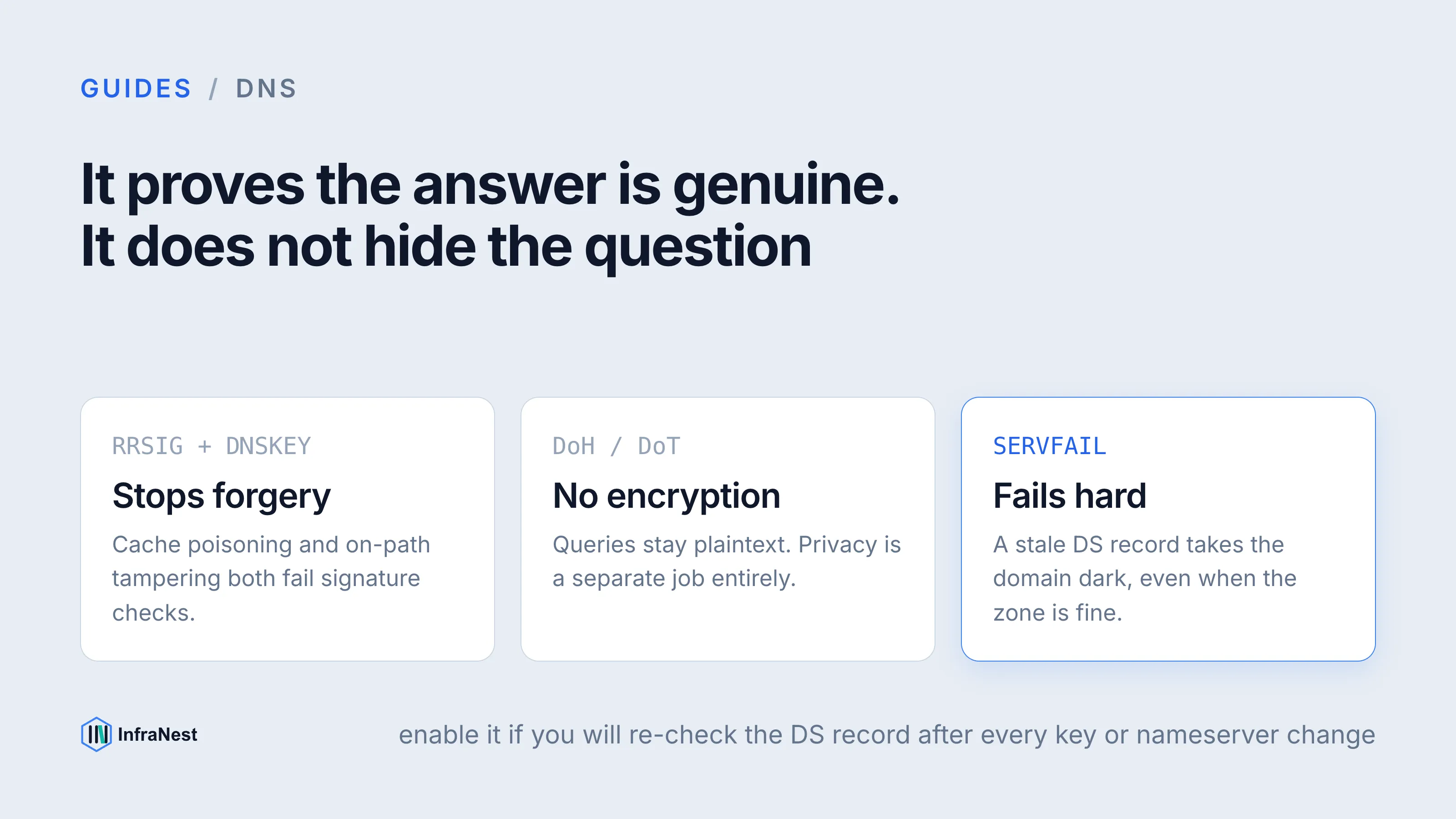
DNSSEC (Domain Name System Security Extensions) adds cryptographic signatures to DNS records so a resolver can verify a response actually came from the zone's owner and wasn't tampered with in transit. It does not encrypt DNS traffic — your queries are still plaintext unless you separately use DNS-over-TLS or DNS-over-HTTPS. What DNSSEC protects against is forgery: an attacker inserting a fake A or MX record into the resolution path so your users end up on the wrong server.
For most domains it's worth enabling, but it's not a checkbox you flick without understanding what breaks if you get it wrong.
What threat does DNSSEC actually solve?
Without DNSSEC, a resolver has no way to confirm that a DNS answer is genuine. That gap is exploited in two well-known ways:
- Cache poisoning / spoofing — an attacker races a forged response to a resolver before the real authoritative answer arrives, planting a fake record (this is the class of attack made famous by the 2008 Kaminsky bug).
- On-path tampering — anyone sitting between the resolver and the authoritative server (a compromised router, a rogue ISP, a man-in-the-middle) can rewrite an unsigned DNS response undetected.
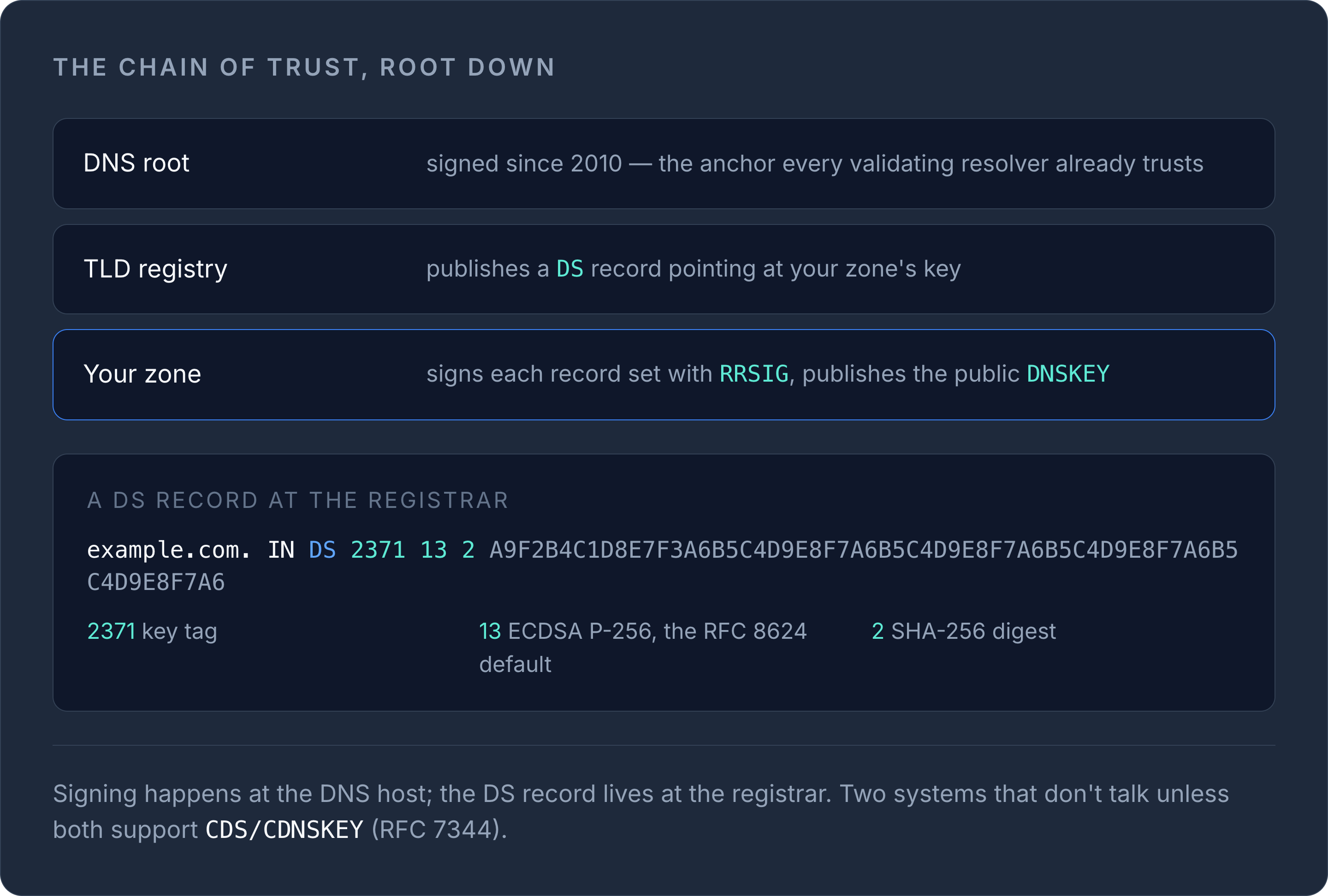
DNSSEC closes both by having the zone owner sign records with a private key. Resolvers that support validation check the signature (RRSIG) against a published public key (DNSKEY) and refuse the answer if it doesn't match. That chain of signatures runs all the way up: your zone → your registrar/TLD registry → the DNS root, which has been signed since 2010. Each level publishes a DS record pointing to the child zone's key, so a validating resolver can walk the whole chain of trust from the root down to your domain.
NoteDNSSEC guarantees authenticity and integrity, not availability or privacy. A signed zone can still go down, and your queries are still visible to anyone watching the wire.
What DNSSEC does not protect against
It's worth being precise here, because the name invites overreach:
- It does not stop DDoS attacks against your DNS servers — in fact, DNSSEC responses are larger (RRSIG and DNSKEY records add bulk), which has historically made signed zones a bigger target for DNS amplification attacks if the provider doesn't apply rate limiting.
- It does not hide what domains you're looking up — that's a job for DoH/DoT, not DNSSEC.
- It does not protect email content or authenticate senders — that's SPF, DKIM and DMARC. If you haven't set those up, start with how to create a secure SPF record.
The real trade-off: operational risk
The honest downside of DNSSEC isn't performance — it's that a validating resolver treats a broken signature as a hard failure, not a fallback. If your signatures expire, or your DS record at the registrar no longer matches your zone's current key (common after a key rollover or a DNS provider migration), validating resolvers will return SERVFAIL and your domain effectively disappears for anyone using a validating resolver — even though the zone itself is fine.
WarningMisconfigured DNSSEC is one of the most common causes of a domain going dark after a DNS provider switch. If you migrate nameservers, remove or update the DS record at your registrar before the old provider's signing keys are decommissioned.
This is why DNSSEC is opt-in on essentially every major platform — Cloudflare, AWS Route 53, Google Cloud DNS and most registrars all leave it off by default and require you to manually generate the DS record and paste it into the registrar's DS management page. There's no safe way to automate that hand-off, because signing happens at the DNS host and the DS record has to be published at the registrar — two different systems that don't automatically talk to each other unless both support the CDS/CDNSKEY automation defined in RFC 7344.
Should you enable it?
Generally yes, if you can commit to monitoring the chain of trust — but weigh it against your operational maturity.
| Scenario | Recommendation |
|---|---|
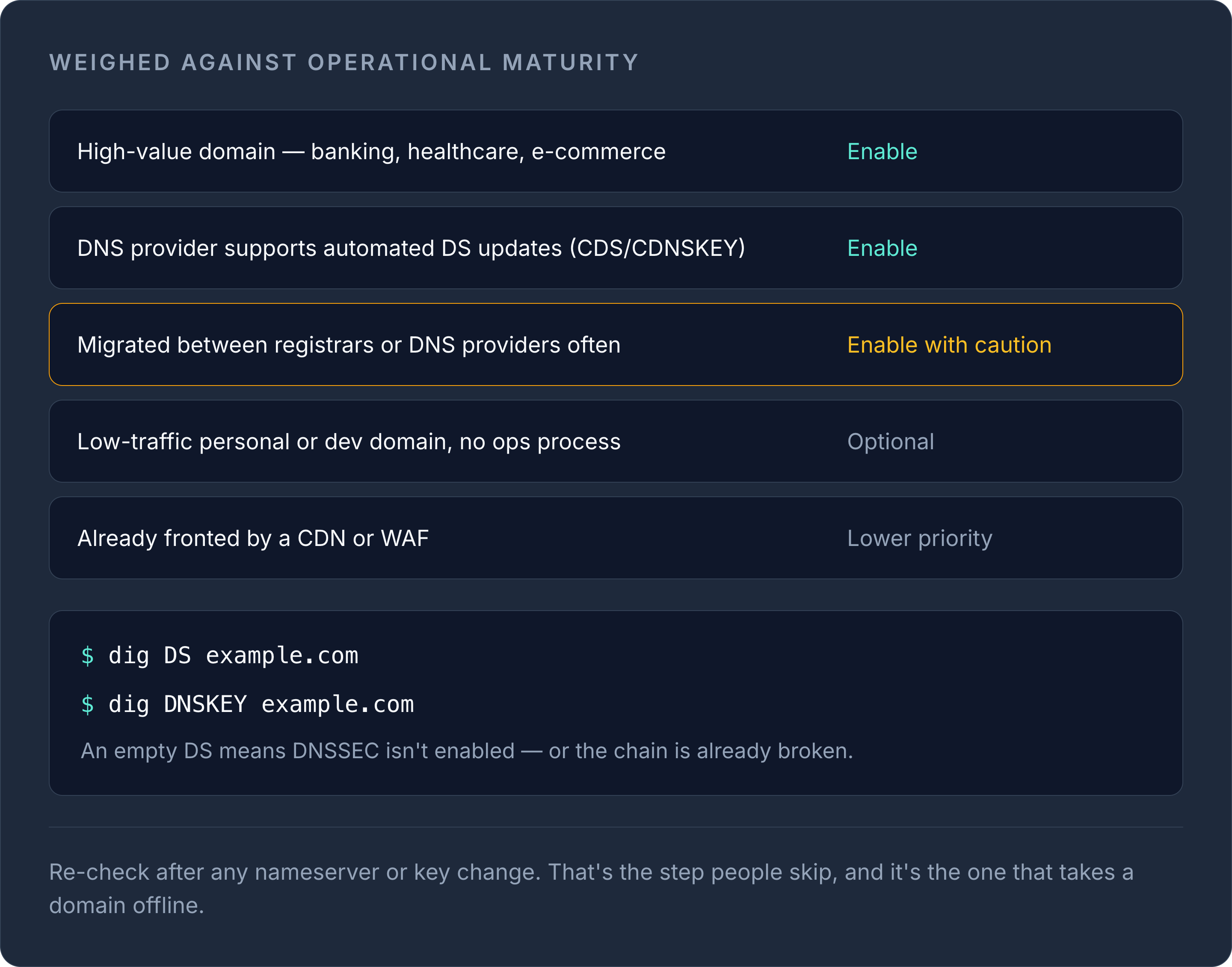
| High-value domain (banking, healthcare, e-commerce) | Enable — spoofing risk outweighs operational overhead |
| Domain behind DNS provider that supports automated DS updates (CDS/CDNSKEY) | Enable — rollover risk is largely handled for you |
| Domain you migrate between registrars/DNS providers often | Enable with caution — always update the DS record during migration, or disable it first |
| Low-traffic personal/dev domain with no dedicated ops process | Optional — benefit is real but small, and a forgotten expired signature can take the whole domain offline |
| Domain already fronted by a CDN/WAF handling most traffic paths | Lower priority — attacker has fewer easy spoofing opportunities, but still worth it long-term |
How to check if a domain already has DNSSEC
You can verify a domain's DNSSEC status without touching a config file. Query for the DS and DNSKEY records directly:
dig DS example.com
dig DNSKEY example.com
A signed, correctly delegated zone returns a DS record at the registry and a matching DNSKEY at the authoritative server. If DS comes back empty, DNSSEC isn't enabled (or the chain is broken). Our free DNS lookup tool does this without a terminal — useful for a quick check before you tell a client their domain is protected.
A typical DS record at the registrar looks like this:
example.com. IN DS 2371 13 2 A9F2B4C1D8E7F3A6B5C4D9E8F7A6B5C4D9E8F7A6B5C4D9E8F7A6B5C4D9E8F7A6
The fields are key tag, algorithm (13 = ECDSA P-256, the current recommended default per RFC 8624), digest type (2 = SHA-256), and the digest itself.
Enabling it without breaking anything
- Turn on DNSSEC signing at your DNS provider — this generates a DNSKEY and a corresponding DS record.
- Copy the DS record to your domain's registrar (a different step from step 1 unless registrar and DNS provider are the same company).
- Wait for the registry to publish it and for TTLs to expire before assuming it's fully live.
- Re-check with
dig DSor the lookup tool above after any nameserver or key change — this is the step people skip.
If you manage DNS and registrar settings for the same domain in one place, this hand-off is far less error-prone — see how our DNS management keeps signing status and registrar-level records aligned instead of split across two dashboards.
For background on how a validating resolver actually walks the chain from root to your zone, see how DNS resolution works. And if you're not yet confident on record types generally, the complete DNS record guide covers what each one does before you layer DNSSEC on top.
If you're managing DNSSEC across multiple domains and providers, keeping DS records and signing status visible in one DNS dashboard is the difference between catching a rollover mismatch in minutes and finding out when a customer reports your site is down.
Frequently asked questions
#Does DNSSEC slow down DNS resolution?
It adds a small amount of overhead because signed responses are larger and validating resolvers do extra cryptographic checks, but for almost all domains this is negligible compared to normal DNS lookup times.
#Can I use DNSSEC and DNS-over-HTTPS together?
Yes, and they solve different problems: DNSSEC verifies the response is authentic, while DoH/DoT encrypts the query in transit so it can't be observed. Using both gives you authenticity and confidentiality.
#What happens if I forget to update the DS record after switching DNS providers?
Validating resolvers will see a DS record that no longer matches your zone's current signing key and return SERVFAIL, effectively taking your domain offline for anyone using a validating resolver until the mismatch is fixed.
#Do I need DNSSEC if my site is already behind HTTPS and a CDN?
HTTPS and DNSSEC protect different layers — HTTPS secures the connection to your web server, DNSSEC secures the DNS lookup that finds that server in the first place. They're complementary, not substitutes.
Was dit artikel nuttig?