You can't secure, renew, or monitor an asset you don't know exists. Infrastructure inventory — a complete, current record of every domain, DNS zone, certificate, server, and IP you're responsible for — is what turns reactive firefighting into predictable operations. Without it, outages and security incidents trace back to the same root cause: something nobody was tracking.
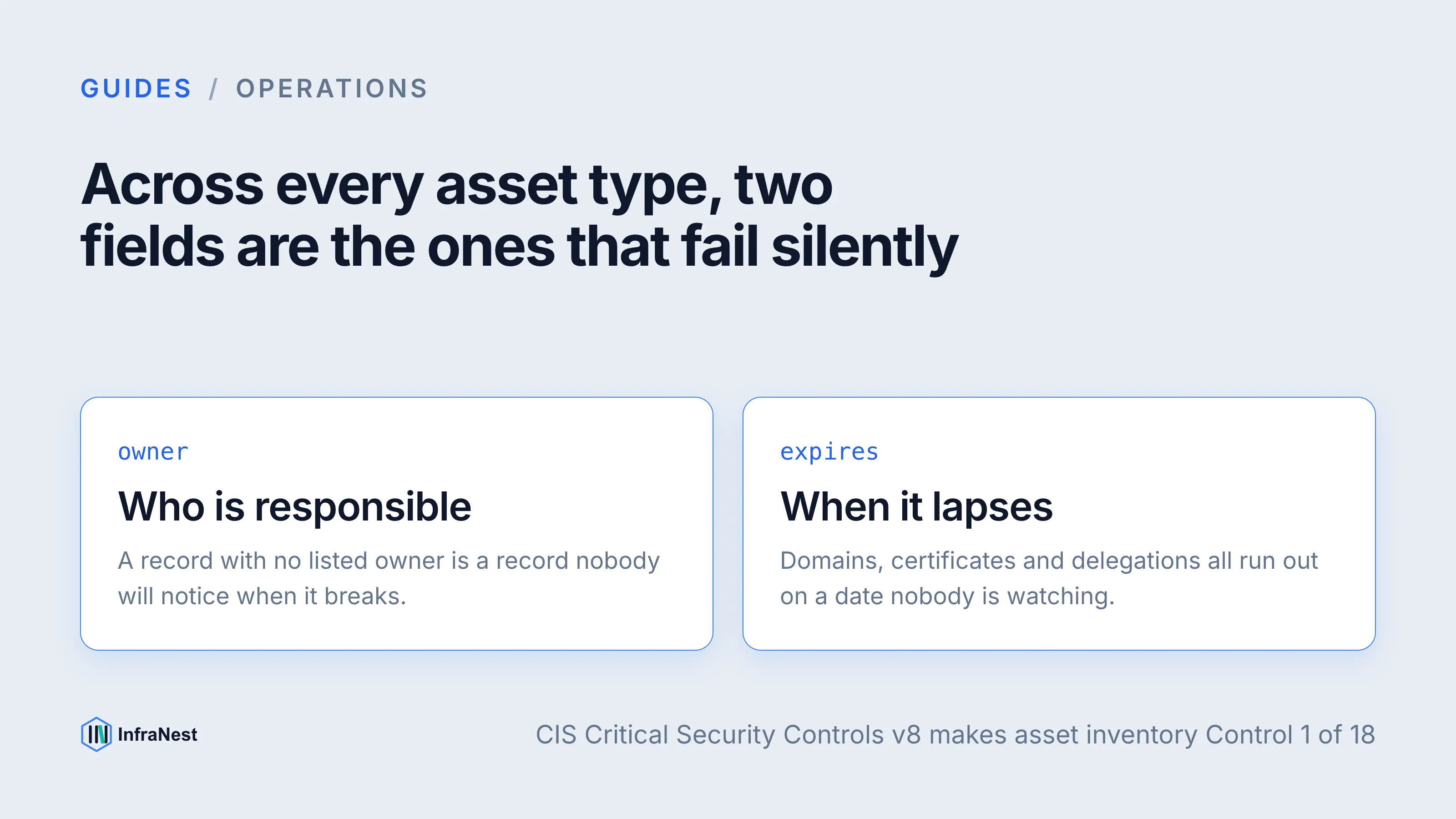
This isn't a theoretical concern. CIS Critical Security Controls v8 makes "Inventory and Control of Enterprise Assets" Control 1 — the very first of 18 controls — because every other control assumes you already know what you're protecting. NIST SP 800-53's CM-8 (System Component Inventory) and PCI DSS v4.0 Requirement 12.5.1 exist for the same reason: you can't patch, restrict, or audit an asset that isn't on a list.
What happens when assets go untracked
Unknown or forgotten assets are one of the most common causes of avoidable downtime and breaches, and the pattern repeats across teams of every size:
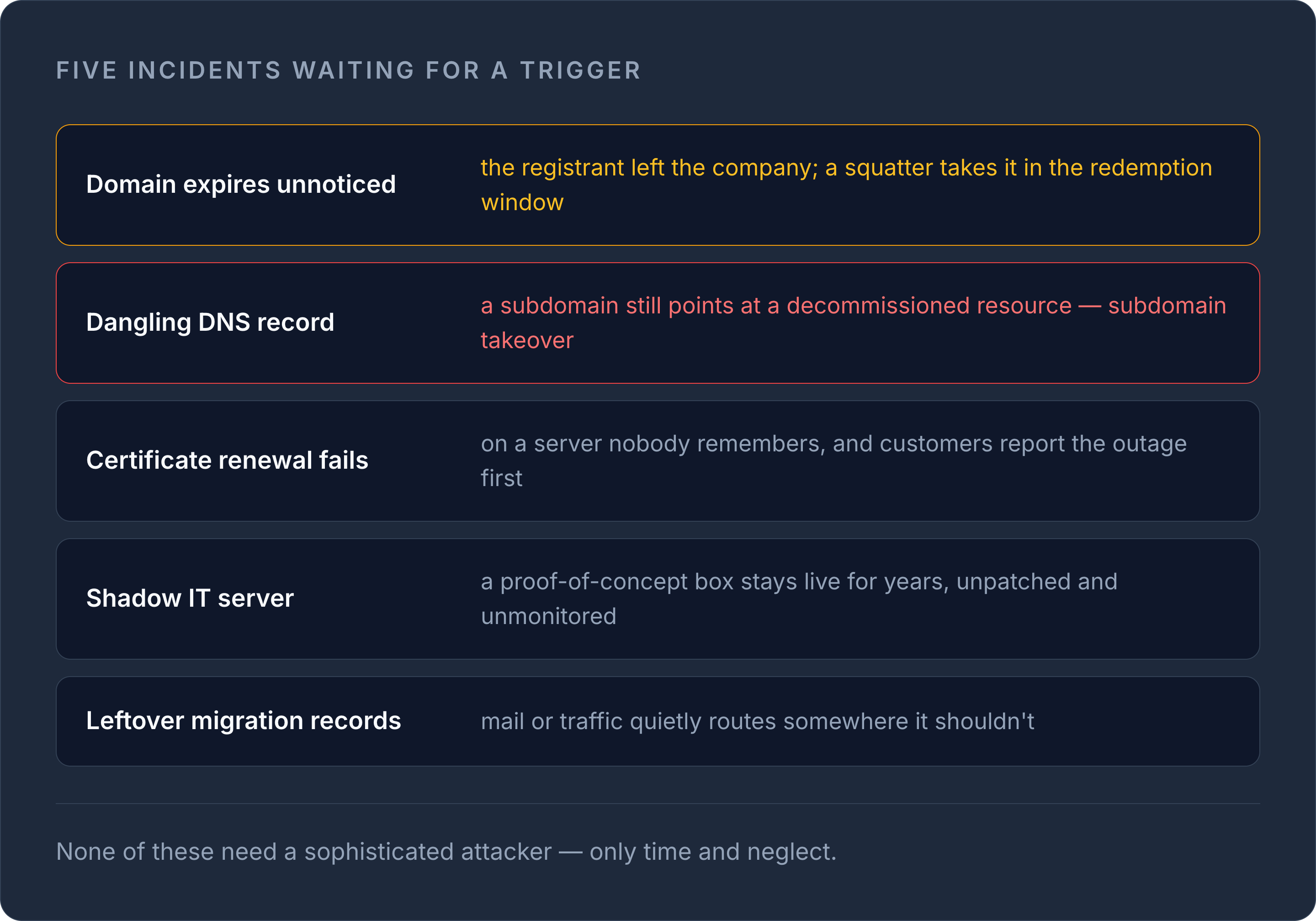
- A domain expires unnoticed because the person who registered it left the company, and a competitor or squatter picks it up during the redemption window. See our guide on catching an expiring domain for how fast this can happen.
- A subdomain still points to a decommissioned cloud resource, creating a dangling DNS record that's ripe for subdomain takeover.
- A certificate renews on a server nobody remembers exists, then silently fails, and the outage isn't caught until customers complain.
- Shadow IT servers spun up for a proof-of-concept stay live for years, unpatched, outside any monitoring or backup policy.
- DNS records left over from a migration quietly route mail or traffic somewhere it shouldn't go.
Each of these is an availability or security incident waiting for a trigger. None of them require a sophisticated attacker — just time and neglect.
WarningDangling DNS records (a CNAME or A record pointing to a resource you no longer control) are a well-documented subdomain takeover vector. If you decommission a server or cloud service, remove the DNS record in the same change — not "later."
What to actually track in an infrastructure inventory
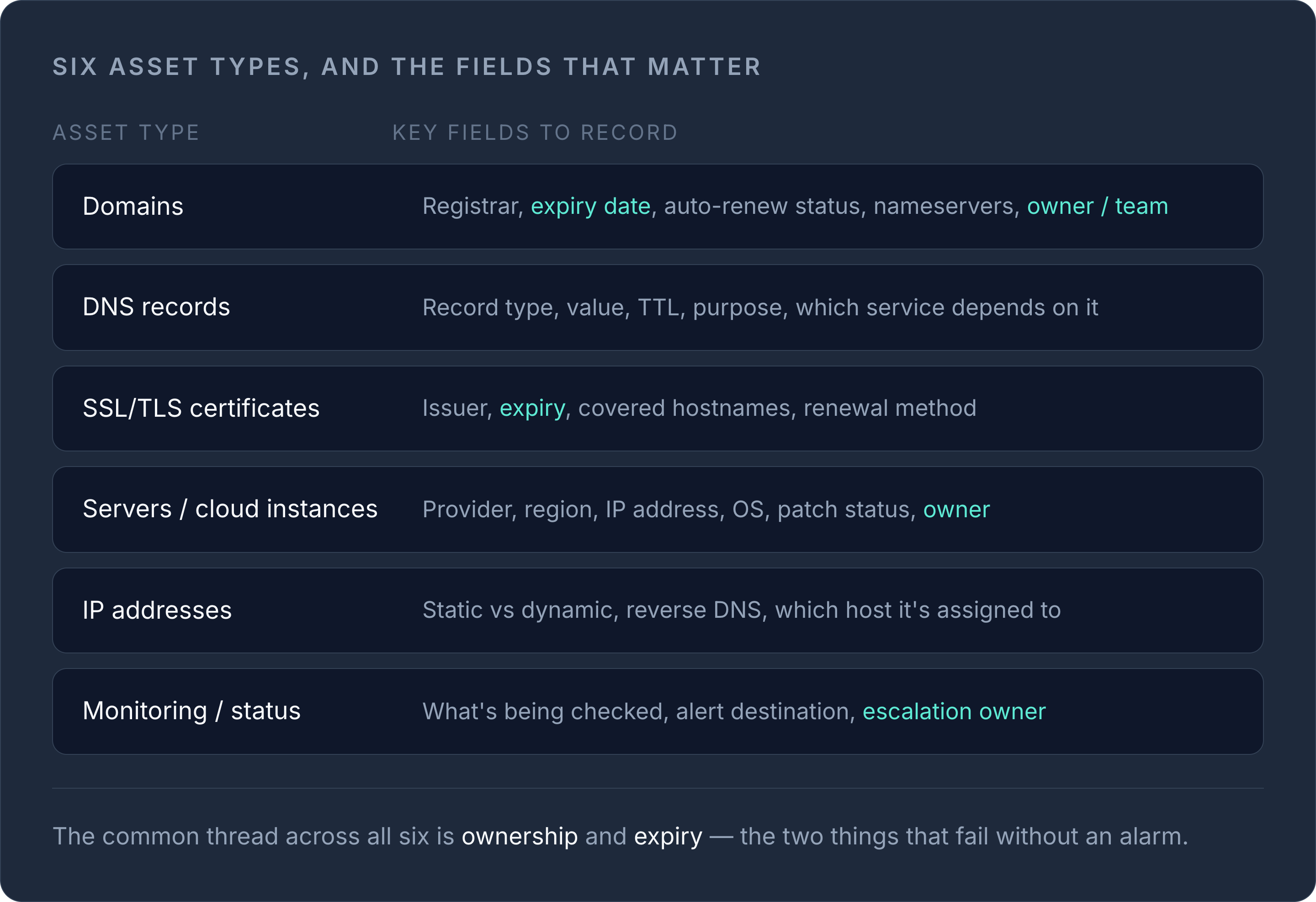
A useful inventory goes beyond a spreadsheet of domain names. At minimum, track:
| Asset type | Key fields to record |
|---|---|
| Domains | Registrar, expiry date, auto-renew status, nameservers, owner/team |
| DNS records | Record type, value, TTL, purpose, which service depends on it |
| SSL/TLS certificates | Issuer, expiry, covered hostnames, renewal method |
| Servers/cloud instances | Provider, region, IP address, OS, patch status, owner |
| IP addresses | Static vs dynamic, reverse DNS, which host it's assigned to |
| Monitoring/status | What's being checked, alert destination, escalation owner |
The common thread across all six is ownership and expiry — the two things that fail silently. A record with no listed owner is a record nobody will notice when it breaks.
Why a single source of truth beats scattered spreadsheets
Most teams don't lose track of everything at once — they lose track gradually, as domains sit with different registrars, DNS is split across providers, and servers land on whichever cloud was cheapest that quarter. Cloud vendors have built their own answers to this (AWS Config and Systems Manager Inventory, Azure Resource Graph, Google Cloud Asset Inventory), but those only cover assets inside one provider. Real infrastructure inventory has to span registrars, DNS providers, and clouds at once, because that's how modern teams actually operate.
This is the gap a unified dashboard closes: instead of checking five registrar logins and three cloud consoles to answer "what do we own and when does it expire," you get one place that tracks it all. InfraNest's domain management gives you expiry dates and ownership across every registrar in one view, and DNS management does the same for records across every provider — so a stale or dangling entry shows up before it becomes an incident, not after.
If you want to sanity-check what's currently live for a domain, run it through our free DNS lookup tool — it's a fast way to spot a record you didn't know was still there.
How to start building one if you don't have it
You don't need a perfect system on day one. Start narrow and expand:
- List every domain your organisation owns, including ones bought for campaigns, brand defence, or old products. Note registrar and expiry for each.
- Pull every DNS zone and record its purpose — delete anything nobody can explain.
- Catalogue certificates and their expiry dates, separate from the servers they sit on, since certs and hosts often move independently.
- List every server and cloud instance by provider, with an owner assigned to each — no owner means it's a candidate for decommissioning.
- Set a review cadence. Quarterly is a reasonable starting point; monthly if your infrastructure changes often.
Once the inventory exists, automation keeps it accurate — see our guide on automating DNS, SSL and server tasks across providers for how to stop re-checking this by hand every quarter.
Start by pulling your domains and DNS into one view with InfraNest's domain and DNS management — it's the fastest way to find out what you're actually running.
Frequently asked questions
#What's the difference between an asset inventory and a CMDB?
A configuration management database (CMDB) typically tracks relationships and dependencies between IT assets for change management, while an infrastructure inventory is a simpler record of what exists, who owns it, and when it expires or needs renewal. Many teams start with an inventory and grow into a full CMDB as complexity increases.
#How often should infrastructure inventory be reviewed?
Quarterly reviews are a reasonable baseline for most teams, but any team making frequent infrastructure changes should review monthly or automate continuous discovery instead of relying on manual audits.
#Does infrastructure inventory help with compliance?
Yes — frameworks including CIS Controls, NIST SP 800-53 (CM-8), ISO/IEC 27001 (Annex A 5.9), and PCI DSS (Requirement 12.5.1) all explicitly require maintaining an asset inventory as a baseline security control.
#What's the most commonly forgotten type of infrastructure asset?
Domains registered for one-off campaigns or brand protection and DNS records left over from completed migrations are two of the most frequently forgotten assets, since neither shows up in day-to-day server or application monitoring.
Cet article vous a-t-il été utile ?