

Conditions let you control exactly when an automation runs, so you're not flooded with alerts for every little change.
Overview
- Without conditions, a rule runs on every matching event.
- With conditions, the rule only runs when the event's details match what you've specified.
- All conditions must match — they're combined with and — unless you use a group (see below).
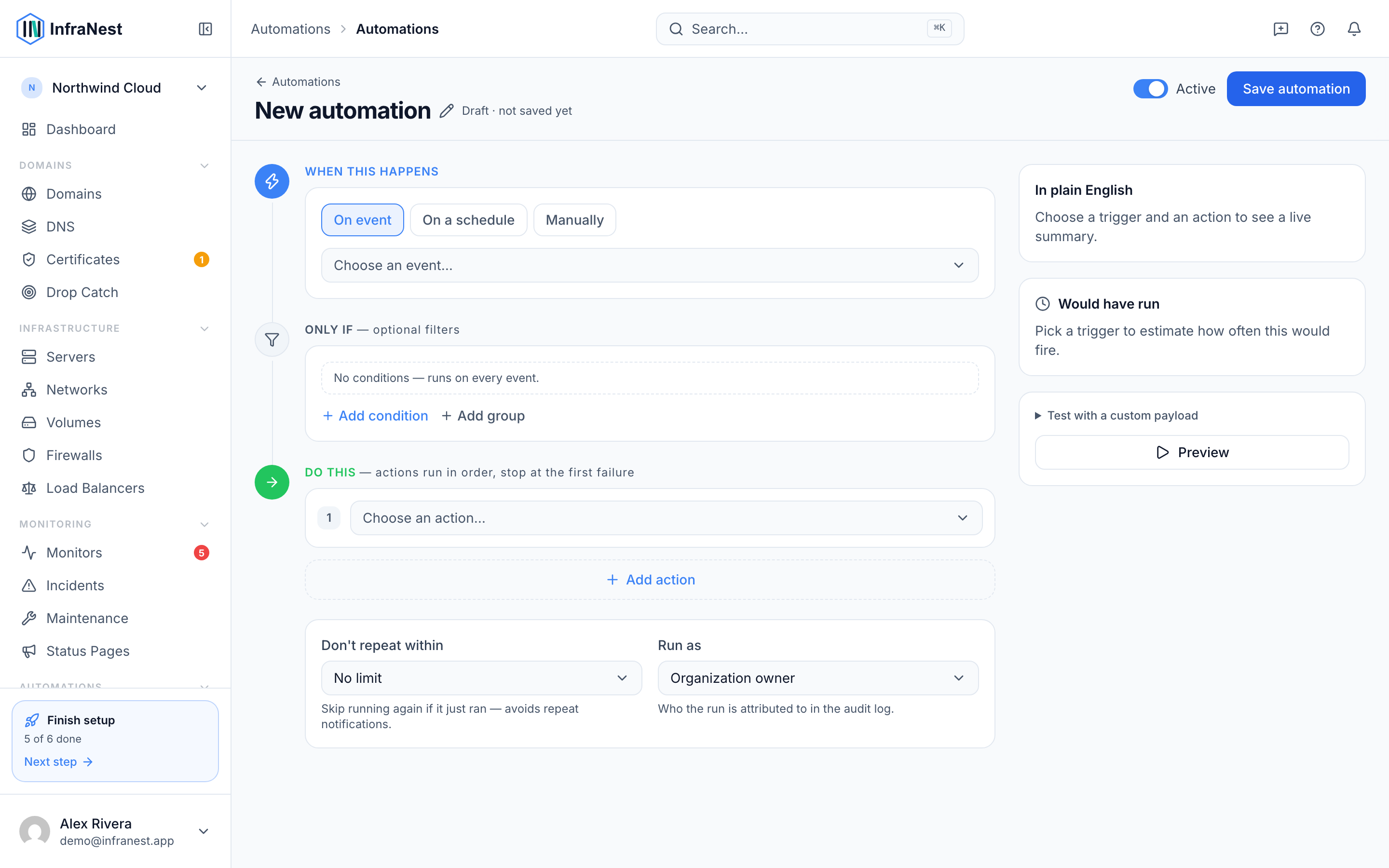
Add a condition
- Open the automation you want to edit, or start a New automation.
- Under Conditions, select Add condition.
- Choose the Field you want to check. The available fields depend on the trigger you picked — for example, a Domain expiring trigger offers Watched domain and Days until expiry, while a Monitor alert trigger offers fields like status and monitor type.
- Choose an Operator — options include equals, not equals, contains, doesn't contain, greater than, greater or equal, less than, less or equal, is one of, is not one of, is set, and is not set.
- Enter the Value to compare against. You can type a fixed value, or select Insert value to use a placeholder from Earlier values — this lets you compare the field to another piece of live data instead of a fixed one.
- Repeat to add more conditions. Use Move up / Move down to reorder them if needed.
- Select Save automation when you're done.
NoteLeave conditions empty to run the automation on every matching event.
Examples of common conditions
- Domain expiring trigger with Days until expiry less than
14— only warn when renewal is close. - Monitor alert trigger with status equals "down" — act on outages, not recoveries.
- DNS record changed (in-app) trigger with record type is one of A, AAAA — only address records.
- Domain status changed trigger with new nameservers contains "cloudflare" — only when a domain moves to Cloudflare.
Mix "and" and "or" with groups
- Select Add condition as usual for your first rule.
- Select Add group to create a group of conditions with its own Match toggle — choose Any (matches if one condition is true) or Match all (every condition must be true).
- Add your conditions inside the group.
- Combine groups and individual conditions at the top level using Any or All under of these conditions to build logic like "(days left < 14 and tag is production) or the certificate is already expired."
- Groups can be nested inside other groups if your logic needs it.
- Select Remove group to delete a group you no longer need.
Restrict a rule to certain times
- Select Add condition.
- Choose Field, then pick one of the built-in time fields: Day of week, Hour of day (0–23), or Weekend.
- Set the Operator and Value — for example, Hour of day (0–23) greater or equal
18to only act after 6pm, or Weekend equals "no" to restrict to weekdays.
NoteTime-based fields are evaluated in the platform's timezone.
Tips
- Use the Preview (dry run) or Test run option to check whether your conditions would have matched a real event before saving.
- Check {n} of {total} matched in the run history to confirm your conditions are behaving as expected.
TipIf you're not sure which fields are available for your trigger, check the Automation triggers and actions article — each trigger lists its own set of fields.
Was this article helpful?
Related articles
About automationsAutomations let InfraNest react to things happening across your infrastructure on its own.Automation examplesA few ready-to-copy automations to show what's possible. Build any of these under Automations → New automation, or start from the Templates tab.Placeholders and formattingPlaceholders let an automation drop live details from the event into a message, title or webhook — so instead of a generic "A certificate is expiring" you…Check your automation runsOnce a rule is live, InfraNest records every time it runs — so you can confirm it's working and see exactly what each action did.