

Automations let you set up rules that run actions automatically whenever something happens in your infrastructure, so you can skip repetitive manual work. This is for anyone who wants InfraNest to react to events on its own — like alerting your team, updating a status page, or restarting a server.
Overview
- A rule reads as When → If → Then: when an event fires, if your conditions match, then it runs your actions in order.
- Rules can be built from scratch or started from a ready-made template.
- Every run is recorded, so you can always check what happened and why.
Create a rule
- Go to Automations and select New automation.
- Under When, pick a trigger — the event that starts the rule. You'll find the full list of triggers under All triggers.
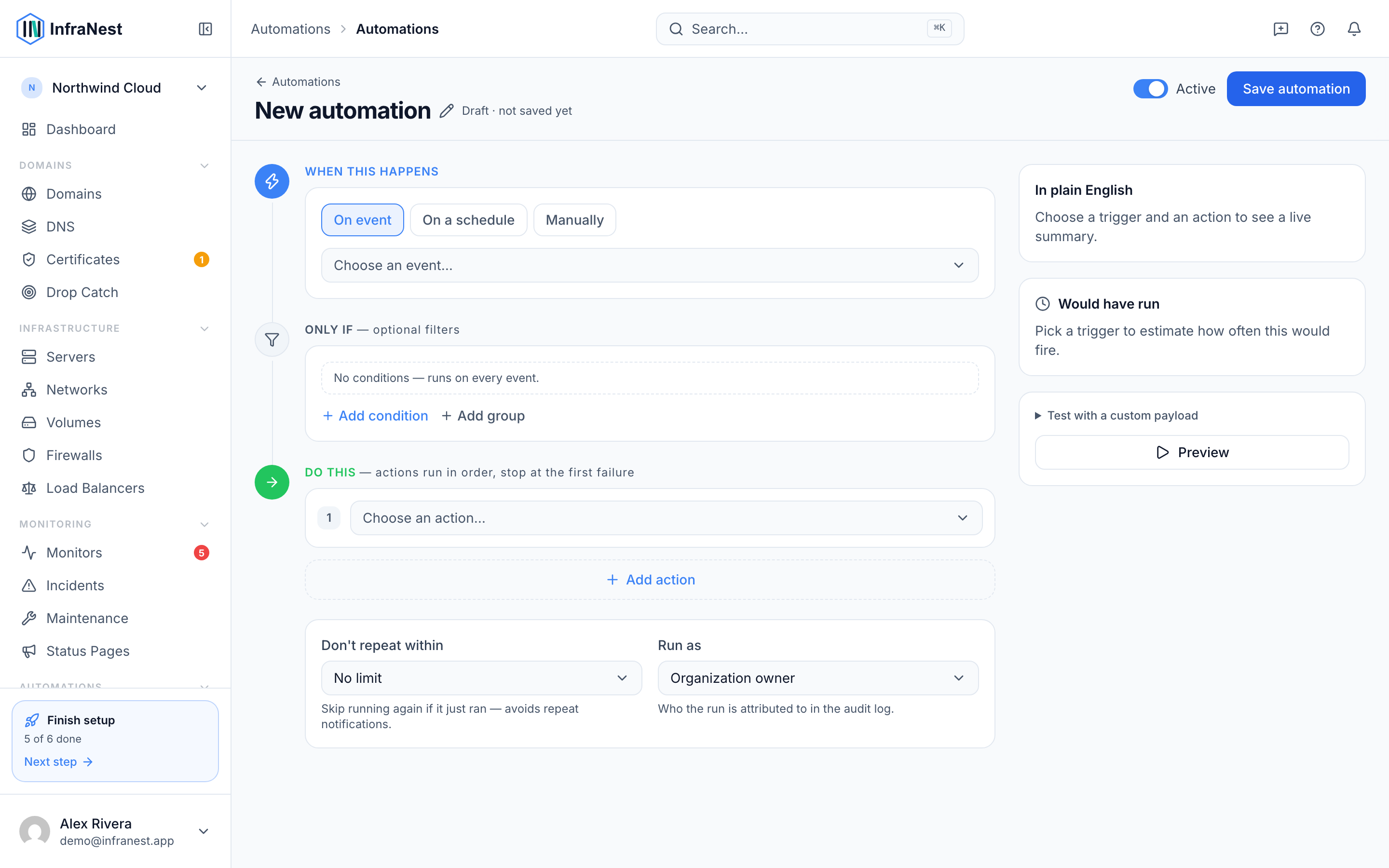
- Under If (optional), select Add condition to narrow down when the rule should run. All conditions must match for the rule to fire.
- Under Then, select Add action to add one or more actions. They run in order, top to bottom.
- Select Preview (dry run) to see what the rule would do against a real example, then select Save automation.
TipUse Preview (dry run) before saving — it shows you exactly what would happen without actually running any actions.
Start from a template
- Go to Automations and open the Template library.
- Select Browse all templates to see the full list, or check Your templates if you've saved your own before.
- Pick a template such as Monitor down → wait, then escalate or Domain expiring → email the customer and select Use (or Use this).
- Adjust the trigger, conditions and actions to fit your setup, then select Save automation.
Manage a rule
- Go to Automations and select All automations to see your full list.
- To pause a rule without deleting it, select Disable. Select Enable to turn it back on.
- To change what a rule does, select Edit, then update the trigger, conditions or actions and select Save changes.
- To stop a rule from firing again too soon after it runs, set a Cooldown (for example, Don't repeat within a chosen time).
- To remove a rule you no longer need, select Delete.
WarningDeleting an automation can't be undone — the rule and its settings are permanently removed.
After it runs
- Go to Automations and open the rule you want to check.
- Select Runs (or Runs · 30d) to see its run history.
- Select Run history to see each run's status — such as Retrying, Awaiting approval, Rejected or Gave up — and the result of every step.
- For a full record across all rules, check the Audit Log.
Troubleshooting
- If a run shows Test run failed, open it to see the specific error message and check that your trigger, conditions and action fields are filled in correctly.
- If a rule seems stuck or shows Auto-disabled after repeated failures, review its recent runs, fix the underlying issue, then select Enable to turn it back on.
- If nothing happens when you expect it to, double-check your conditions — remember all conditions must match for the actions to run.
Was this article helpful?
Related articles
About automationsAutomations let InfraNest react to things happening across your infrastructure on its own.Automation conditionsConditions decide when a rule actually runs. Without them, a rule runs on every matching event; with them, it runs only when the event's details match.Automation examplesA few ready-to-copy automations to show what's possible. Build any of these under Automations → New automation, or start from the Templates tab.Placeholders and formattingPlaceholders let an automation drop live details from the event into a message, title or webhook — so instead of a generic "A certificate is expiring" you…