

Learn how to confirm your automations are working and see exactly what each action did every time a rule runs, whether you're still building it or it's already live.
Overview
- InfraNest keeps a record of every time an automation runs, so you can check it worked and review each action's outcome.
- You can check a rule before saving it, run it on demand once saved, and dig into the full history of past runs.
- Rules that keep failing are flagged automatically, and every run is also logged in your Audit Log.
Preview a rule before saving
- While building your rule, look for Preview (also shown as Preview (dry run)).
- Select it to see what the rule would do, tested against a real recent example from your account.
- Review the Dry-run result — this is a safe check that does not actually perform any actions.
- Adjust your rule and preview again until the outcome looks right, then use Save automation.
Test a saved rule
- Open the automation you want to check from All automations.
- Select Test run (you can also use Test run with sample event or Test with a custom payload if you want to check specific data).
- Review the result. If something goes wrong, you'll see Test run failed or Test run failed: {error} with details.
- Make any needed changes and test again before relying on the rule.
Check run history
- Open the automation you want to review.
- Go to the Runs tab (also shown as Runs · 30d) to see its recent runs.
- Select a specific run to see its actions as steps, listed in order.
- Check the status of each step — it will show as succeeded, failed, or skipped — along with the Output or error message.
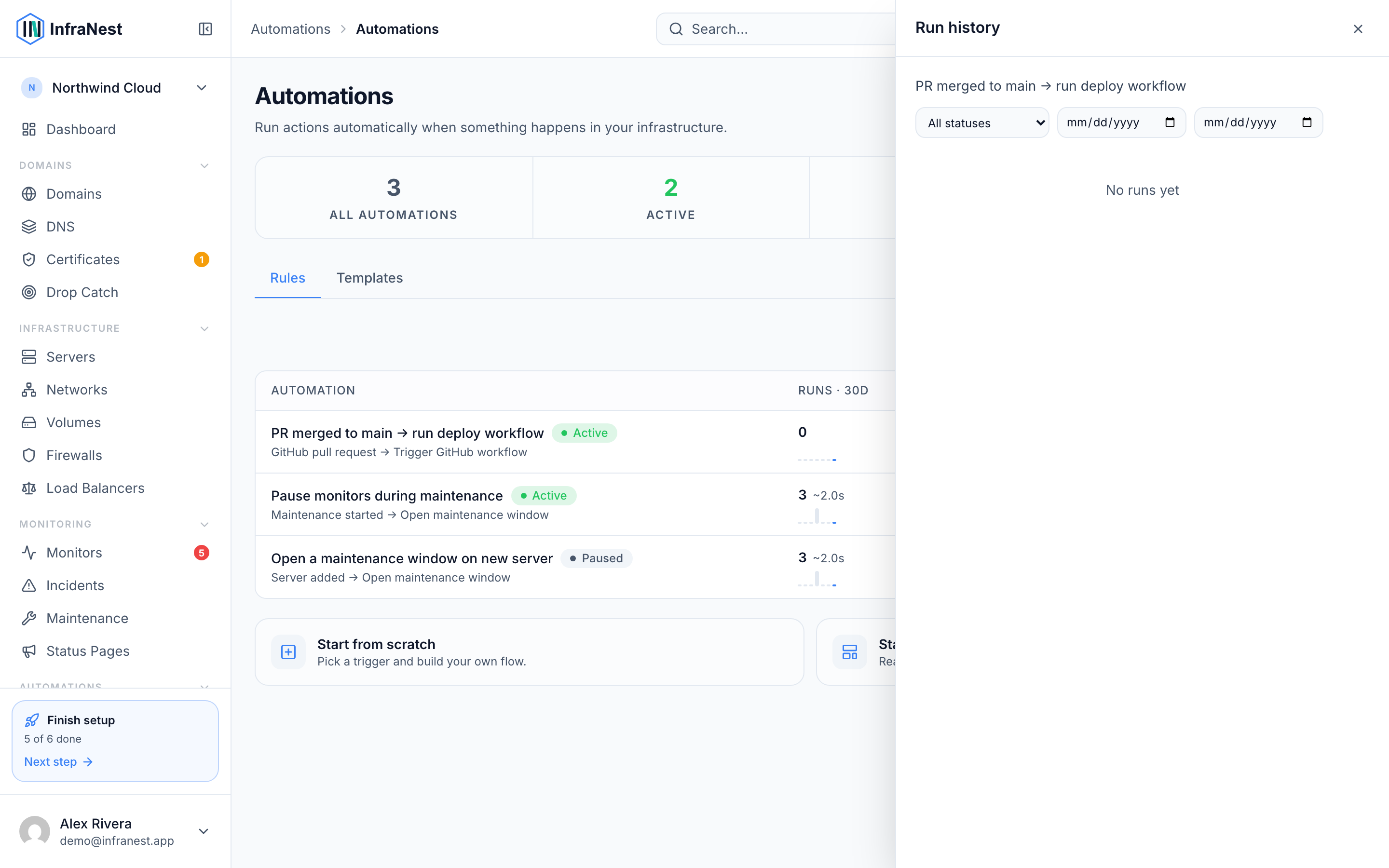
- Use this view whenever a rule didn't do what you expected — it shows exactly where things went right or wrong.
TipThe All automations list also shows Last run and how many times each rule has run, so you can spot problem rules at a glance.
Tips
- If you've set a Cooldown on a rule, it won't run again until the wait time has passed — this stops a burst of events from spamming the same automation.
- Rules that keep failing are automatically flagged (Auto-disabled after repeated failures), so you can fix or disable them before they cause more issues.
NoteEvery run — successful or not — is also recorded in your Audit Log, giving you a complete history outside the automation itself.
Was this article helpful?
Related articles
About automationsAutomations let InfraNest react to things happening across your infrastructure on its own.Automation conditionsConditions decide when a rule actually runs. Without them, a rule runs on every matching event; with them, it runs only when the event's details match.Automation examplesA few ready-to-copy automations to show what's possible. Build any of these under Automations → New automation, or start from the Templates tab.Placeholders and formattingPlaceholders let an automation drop live details from the event into a message, title or webhook — so instead of a generic "A certificate is expiring" you…