

Incidents are automatic records InfraNest creates whenever a monitored service actually goes down, so you and your team can track, discuss, and review outages. This is for anyone who wants to know what's failing right now — or what failed last week.
Overview
- When a check confirms a real failure, InfraNest opens an incident with the impact and likely cause, and tracks how long it lasts.
- Incidents close themselves automatically once the service recovers — no manual step needed.
- You can acknowledge an incident to let your team know someone's handling it, and post updates as the situation develops.
- Incidents caused by planned maintenance are marked as planned, so they don't skew your uptime numbers.
Review and manage an incident
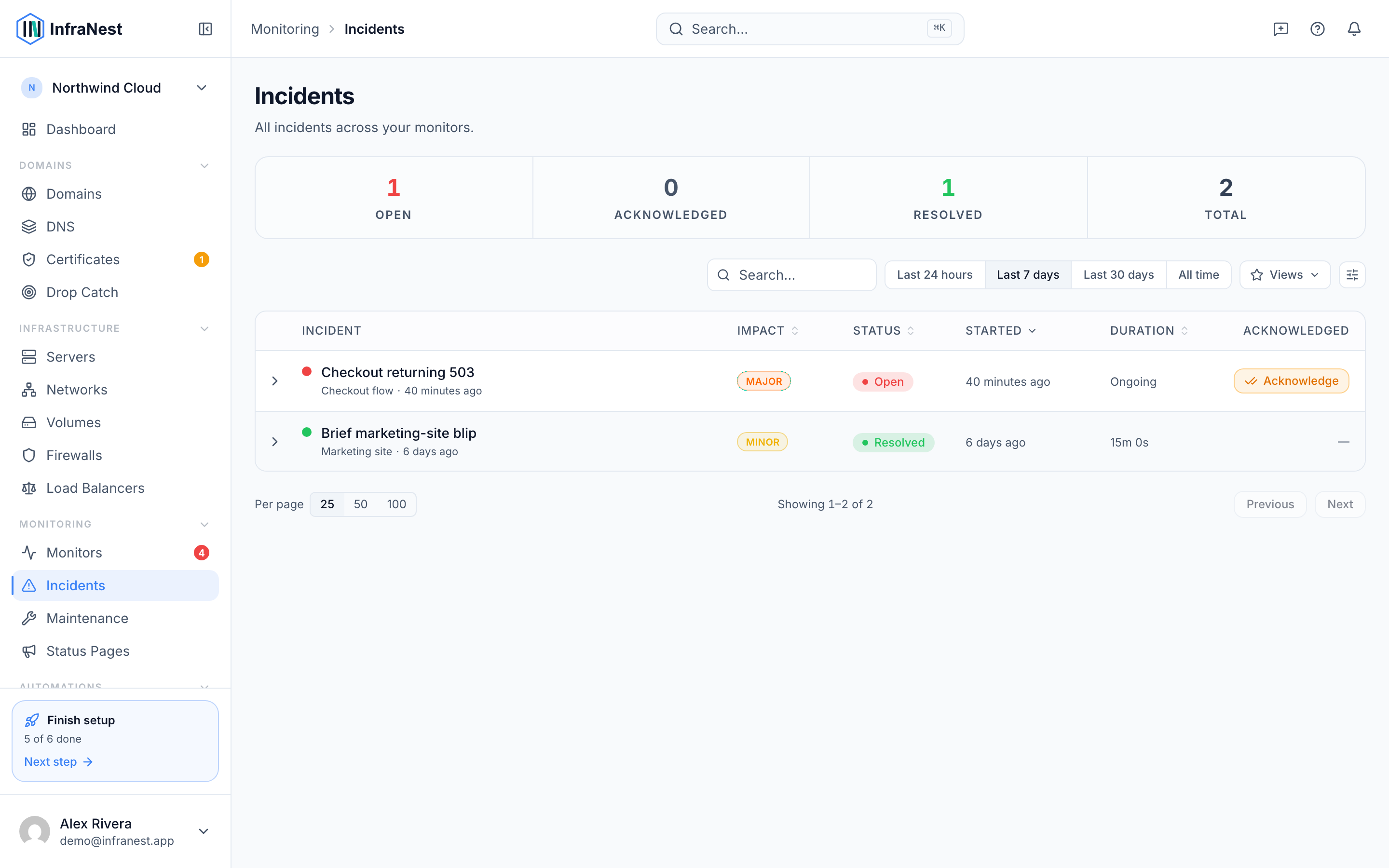
- Open Incidents from the sidebar to see the full list.
- Use Filter to narrow the list down to Active, acknowledged, or resolved incidents.
- Select an incident to open its full timeline.
- Acknowledge it so teammates know it's being worked on.
- Post an update to the timeline as you learn more or take action.
- Once the underlying check recovers, the incident resolves on its own — you don't need to close it manually.
Set up dependencies to avoid alert storms
If one outage would naturally cause several checks to fail at once (for example, a shared server or network going down), tell InfraNest about the relationship instead of getting flooded with separate alerts.
- Open the check that represents the root cause (the "parent").
- On the checks that would fail because of it (the "children"), set them to depend on the parent.
- When the parent goes down, alerts for its dependent children are suppressed — you get one incident for the real cause, not ten.
Follow an incident from your email
- When something goes down, you'll get an email notifying you.
- When it recovers, you'll get a second email — even if that destination is set to critical alerts only, and even outside its quiet hours. This message tells you how long the outage lasted and how the service is performing now.
- Select View incident in either email to jump straight to that incident's timeline and comment box, no matter how old it is.
Browse the Incidents page
- Open Incidents from the sidebar.
- Use Filter to see incidents by status — open, acknowledged, or resolved.
- Select any incident to open its full timeline.
NoteIf you arrive at an incident via a View incident link from an email, you'll see just that one incident with a notice at the top. Select Show all incidents to return to the full list.
Tips
TipSet up dependencies between related checks early — it keeps your team focused on the real cause during an outage instead of digging through duplicate alerts.
Was this article helpful?