

Keep an eye on how your servers are performing, and get notified automatically when something needs attention. This is for anyone running servers in InfraNest who wants to catch performance problems before they cause downtime.
Overview
- InfraNest continuously collects each server's CPU, network, and disk activity.
- These are displayed as easy-to-read graphs so you can spot trends at a glance.
- You can set up alert rules that watch a metric and notify you if it stays too high for too long.
See the metrics
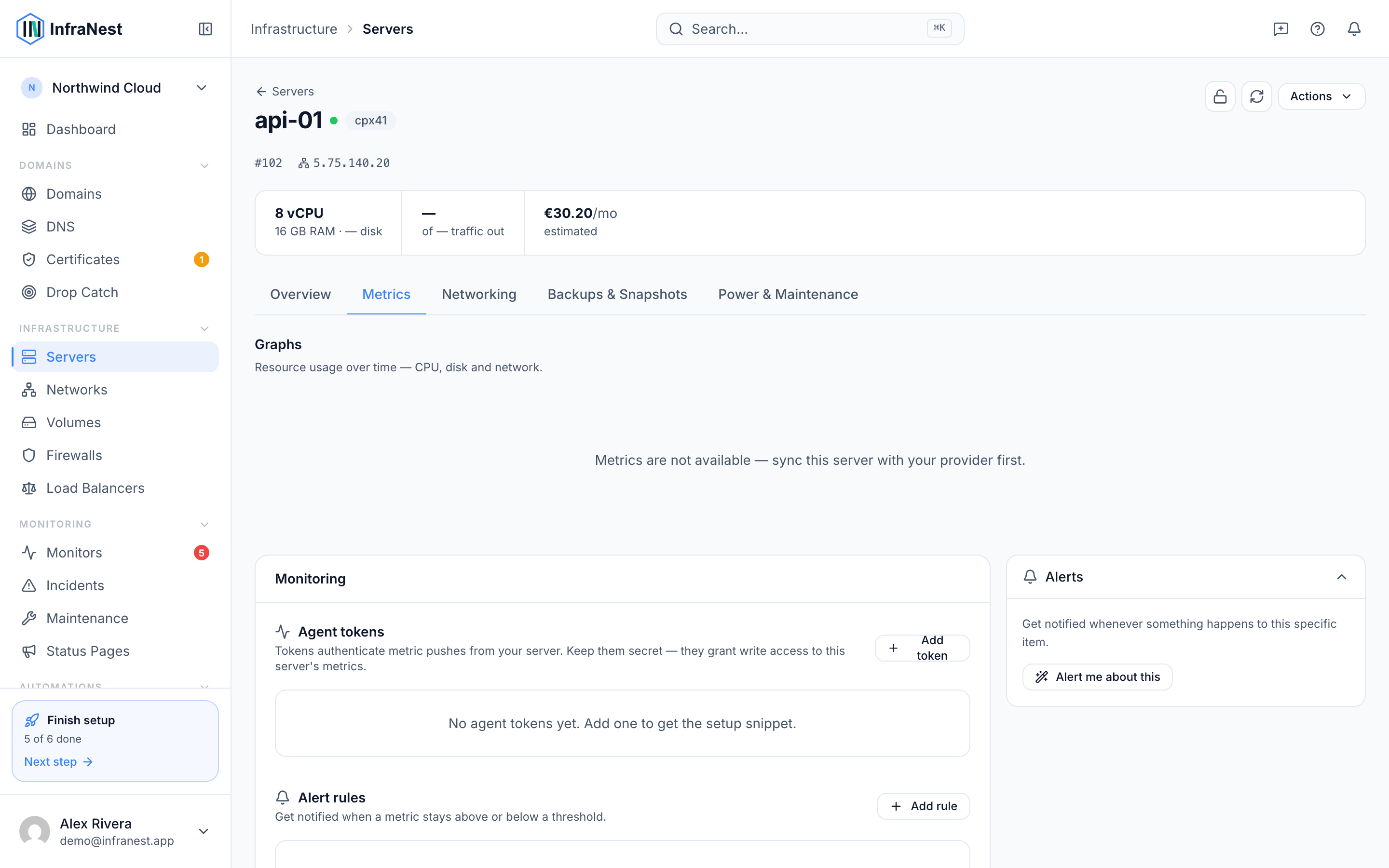
- Open the server you want to check.
- Go to the Metrics tab.
- Review the live graphs for CPU usage, Network in, Network out, Disk read, and Disk write.
NoteYou can also see a combined metrics overview across all your servers from the main Dashboard, so you don't have to check each server individually.
Set up an alert
- On the server, open Alert rules.
- Select Add metric alert.
- Choose the Metric you want to watch (CPU usage, Network in, Network out, Disk read, or Disk write).
- Set the threshold — whether the alert should trigger above (>) or below (<) a value.
- Set for {n} min to define how long the breach must last before it counts.
- Select Save.
The rule only fires after the metric stays over (or under) the threshold for the full duration you set, so a brief spike won't trigger a false alarm. Once triggered, InfraNest opens an incident under Incidents and notifies your configured Alert Channels. When the metric returns to normal, the incident resolves automatically — no action needed from you.
NoteThese incidents appear alongside your uptime-monitoring incidents, so server health and service uptime are all in one place.
Troubleshooting
- Not seeing any data on the Metrics tab? The page may still be loading — look for Loading metrics… and wait a moment, or select Refresh.
- Alert never fires even though usage looks high? Check that the breach lasted the full duration you set in for {n} min — short spikes that recover quickly won't trigger the rule.
- Want to stop a noisy rule temporarily? Open Alert rules and use Disable rule instead of deleting it, so you can turn it back on later with Enable rule.
Was this article helpful?