

Automate with GitHub lets you build rules that react to activity in your GitHub repositories and take action back on GitHub — no scripts or code required. It's for anyone managing infrastructure who wants issues, deployments, and workflows to stay in sync automatically.
Overview
- Rules watch for GitHub events (like a failed workflow or a new pull request) and trigger actions automatically.
- You can create GitHub issues, comment on them, trigger workflows, merge pull requests, and more — all from InfraNest.
- Everything is set up visually in the automation builder, using the GitHub group of triggers and actions.
Before you start
- Go to Integrations and select Connect GitHub to link your account.
- Once connected, GitHub triggers and actions appear together under the GitHub group when you build an automation.
NoteIf you pick a GitHub trigger before connecting, InfraNest will remind you to connect first.
React to GitHub activity
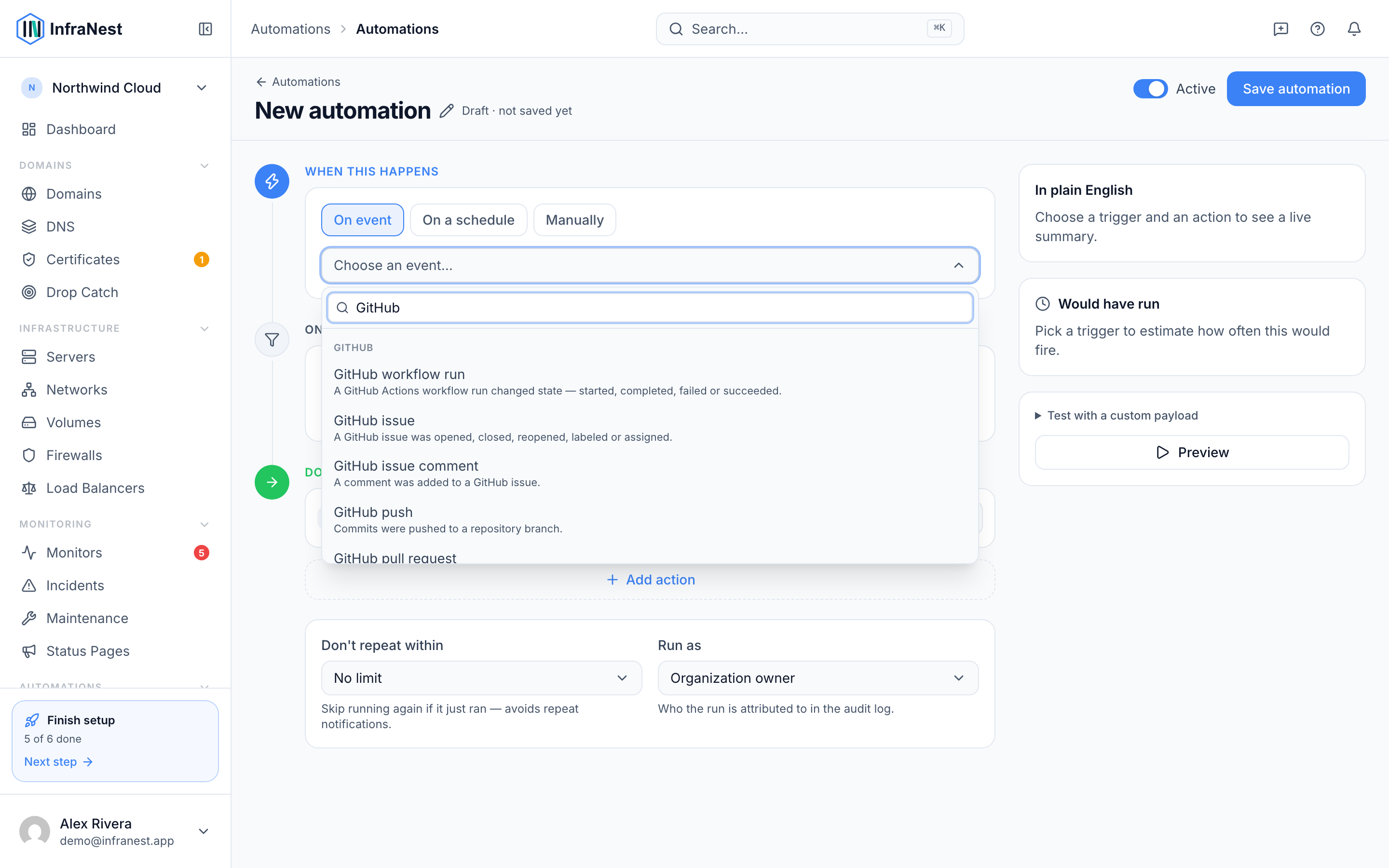
- In the automation builder, start a new rule under When this happens.
- Choose a GitHub trigger, such as GitHub workflow run, GitHub issue, GitHub issue comment, GitHub push, GitHub branch/tag created, GitHub branch/tag deleted, GitHub pull request, GitHub PR review, GitHub release, GitHub deployment, GitHub deployment status, GitHub commit status, or GitHub check run / GitHub check suite.
- Add Only if filters to narrow down the trigger — for example, only for a specific Repository (owner/repo), only for the
mainBranch or tag, only for failures, or only for your Organization rather than a personal account. - As you type in the repository or account fields, InfraNest suggests your connected repositories and accounts.
Act on GitHub
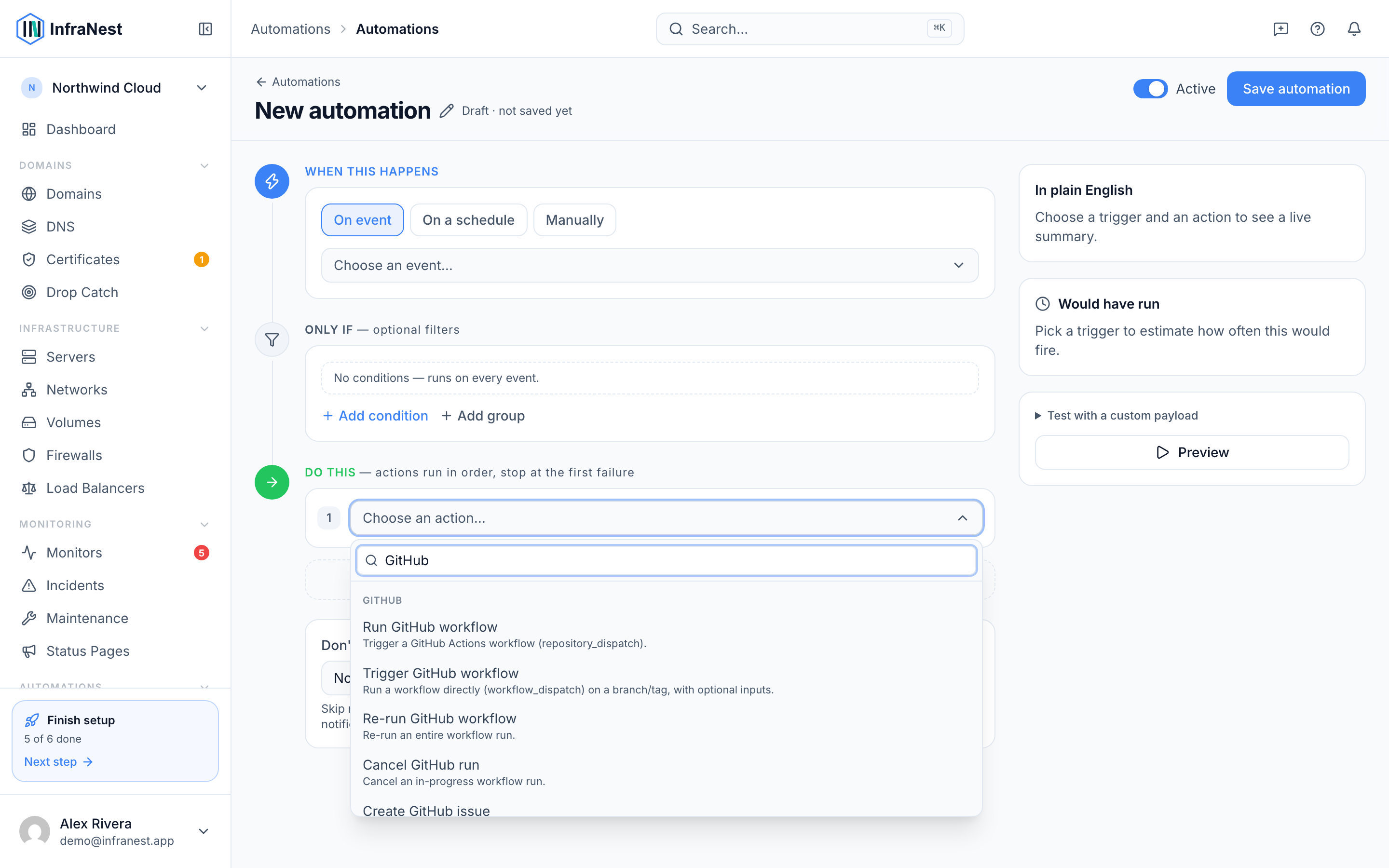
- Under Do this, select Add action.
- Choose a GitHub action to run. For workflows: Trigger GitHub workflow, Re-run GitHub workflow, Re-run failed jobs, or Cancel GitHub run.
- For issues: Create GitHub issue, Comment on GitHub issue, Update GitHub issue, Close GitHub issue, Reopen GitHub issue, Add issue labels, Remove issue label, or Assign GitHub issue.
- For pull requests: Merge pull request, or Request PR review (choose people or a Teams entry).
- For deployments: Create GitHub deployment, then Set deployment status.
- For releases: Create GitHub release.
- For commits: Set commit status to mark success, failure or pending.
- Fill in fields like Repository (owner/repo), Workflow file or id, Target branch, Environment, Labels (comma-separated), Assignees (comma-separated), and Teams — these offer a searchable list from your connected GitHub, or you can type a value or insert a placeholder from the trigger.
Examples
- SSL renewal failed → Create GitHub issue, label it
infrastructure, and use Assign GitHub issue to assign your DevOps team. - A monitor recovered → Comment on GitHub issue and then Close GitHub issue.
- A pull request merged into
main→ Run GitHub workflow to deploy, then Set deployment status. - Your production health check passed → Set commit status to success.
- A release was published → Post status-page announcement.
Tips
TipWhen one step creates something — like an issue or a deployment — later steps in the same rule can automatically reuse it, so you don't have to re-enter the details.
Troubleshooting
- A GitHub trigger never fires: Make sure GitHub is connected and that the installed app is subscribed to that kind of event. Ask your administrator to check the app's event subscriptions.
- Can't request a review from a team: Requesting review from a Teams entry requires an Organization connection, not a personal account.
- An action is missing or greyed out: Some actions require a higher plan — these show a Pro badge in the builder.
Was this article helpful?