

Connect Zapier so InfraNest and Zapier can trigger each other automatically — useful for anyone who wants alerts and routine fixes to happen without manual steps.
Overview
- Send InfraNest events (a domain expiring, a monitor going down, a certificate about to lapse) into Zapier to start a Zap.
- Let a Zap trigger InfraNest to open a maintenance window, pause a monitor or resolve an incident.
- Both directions work by copying a URL between the two tools — nothing to install.
Before you start
Get a Catch Hook URL from Zapier:
- In Zapier, create a Zap and choose the Webhooks by Zapier trigger.
- Choose the Catch Hook event.
- Copy the URL Zapier shows — it looks like
https://hooks.zapier.com/hooks/catch/123456/abcdef.
Send InfraNest events to Zapier
- Go to Integrations → Zapier.
- Select Add endpoint and paste the Catch Hook URL.
- Copy the signing secret shown once after saving, if you want to verify that deliveries really came from us.
- Select Send test event and pick the event it should imitate. Zapier can't map any fields until it has received something, so do this before continuing in Zapier.
- Choose what gets sent: under Start an automation that posts to Zapier, pick a starting point like Send everything to my system, or build your own rule.
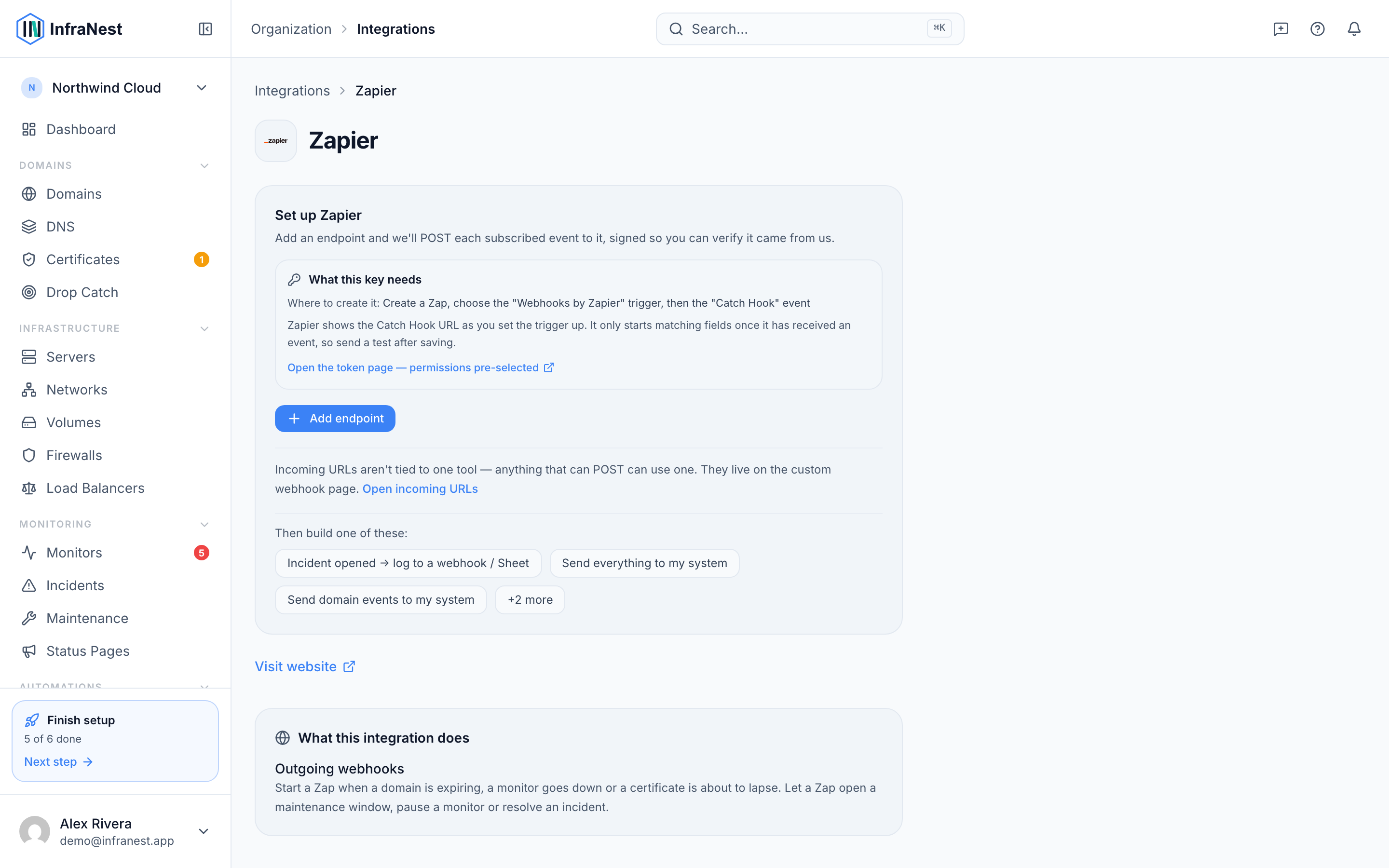
NoteAdding the endpoint doesn't send anything on its own — it tells us where to send. An automation decides what gets sent, which is why step 5 matters. One rule can cover every event, or you can narrow it to the ones you care about.
Let Zapier trigger InfraNest
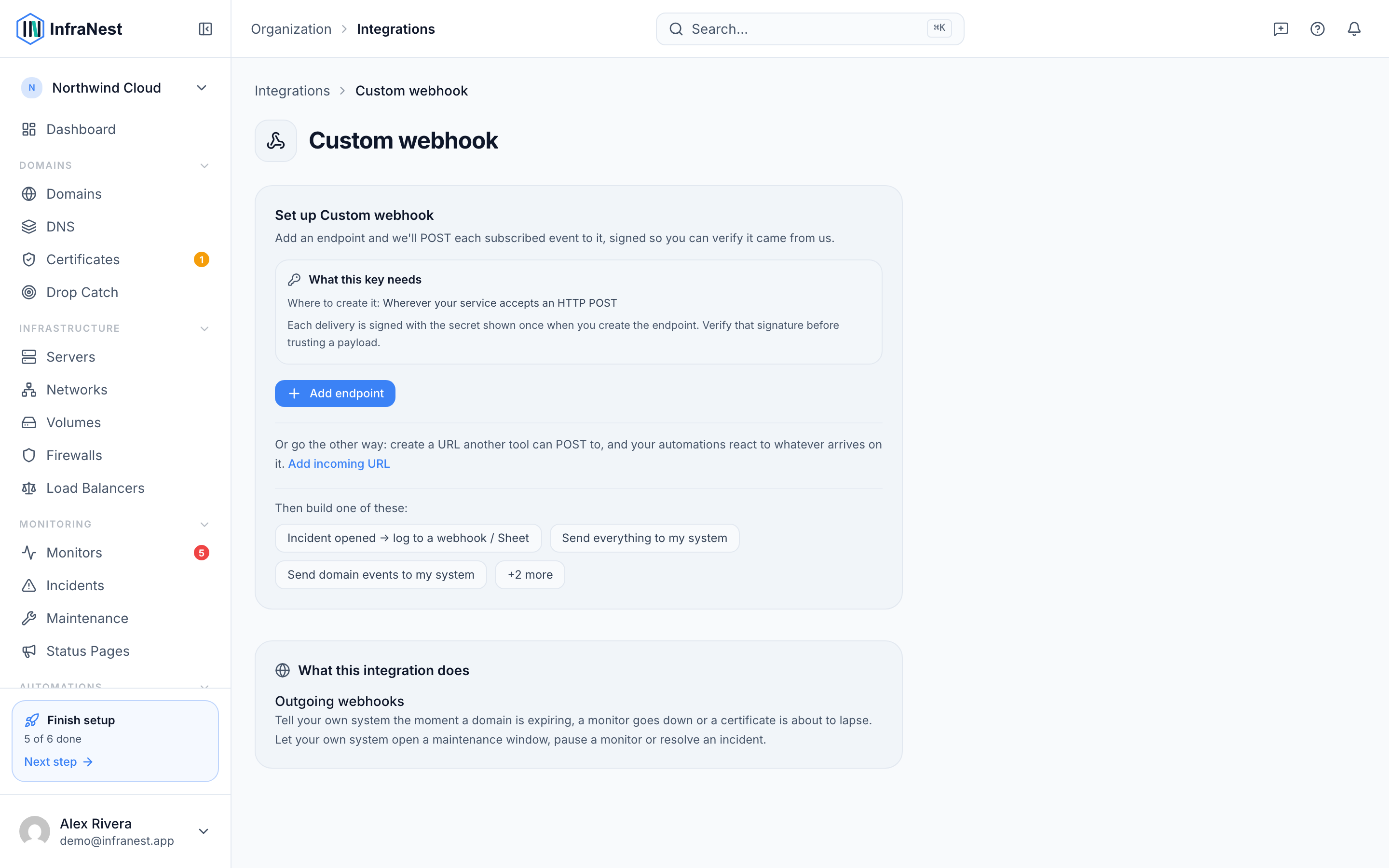
- Go to Integrations → Custom webhook → URLs we give you and select Add incoming URL.
- Give it a name you'll recognise later — you pick it by name when writing the rule.
- Optionally set a shared secret, so a leaked URL on its own isn't enough to trigger anything.
- Copy Your URL into a Webhooks by Zapier action in your Zap, set to POST.
- Back in InfraNest, use Start an automation Zapier can trigger and add what should happen — open a maintenance window, pause a monitor, resolve an incident.
Tips
- You can add more than one endpoint — for example one Zap for incidents and another for domains.
- Both directions keep a delivery log on the integration page, so you can see what went out and what arrived.
WarningThe signing secret is shown once and never again, and your incoming URL works like a password — anyone holding it can trigger your organization's automations. Set a shared secret, and regenerate the URL immediately if it ever leaks.
Troubleshooting
Zapier shows no fields to map. Its Catch Hook only learns the structure once it has actually received something. Select Send test event in InfraNest, then continue setting up the Zap.
Nothing arrives in Zapier. Check that an automation actually posts to the endpoint — the endpoint alone is only a destination. The delivery log on the Zapier page shows whether we sent anything at all.
Your Zap doesn't trigger InfraNest. Confirm the Zap posts to the exact incoming URL, and that the shared secret — if you set one — is sent as the X-InfraNest-Secret header.
Was this article helpful?